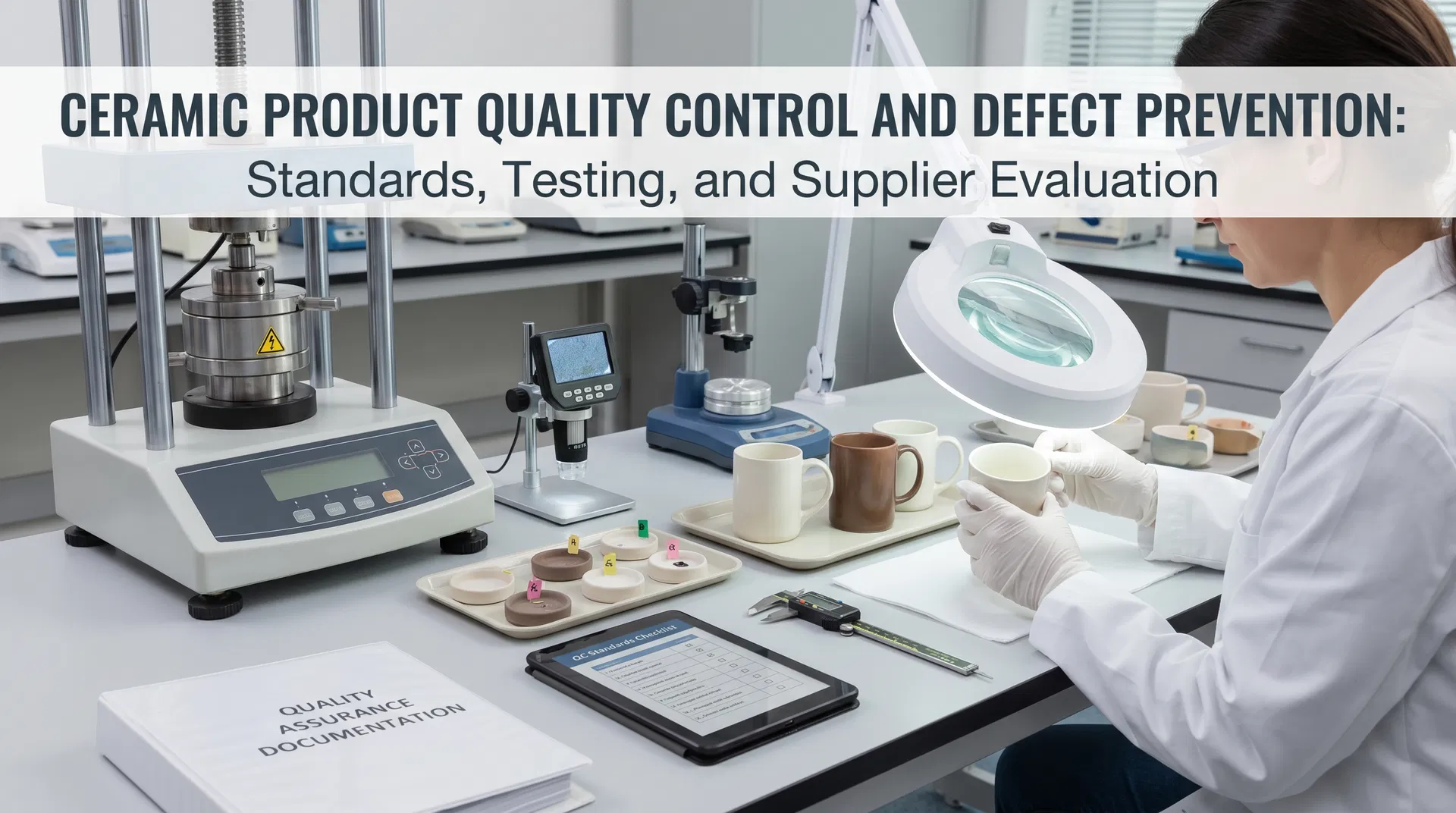
Ceramic Product Quality Control and Defect Prevention: Standards, Testing, and Supplier Evaluation
Custom Development Guide

Ceramic Product Quality Control and Defect Prevention: Standards, Testing, and Supplier Evaluation

Huarui CeramicApril 26, 2026

Ceramic Product Quality Control and Defect Prevention: Standards, Testing, and Supplier Evaluation

Introduction

Quality control is the cornerstone of successful ceramic souvenir mug business. For B2B retailers and bulk purchasers, understanding quality standards, defect types, testing procedures, and supplier evaluation methods is essential for maintaining customer satisfaction and protecting brand reputation. This comprehensive guide explores ceramic quality control frameworks, common defects, testing protocols, and strategies for ensuring consistent product excellence across large orders.

Understanding Ceramic Quality Standards

International Quality Standards

ISO 9001:2015 - Quality Management Systems

  • Establishes systematic quality management requirements
  • Requires documented procedures and continuous improvement
  • Applicable to all manufacturing operations
  • Certification indicates supplier commitment to quality
  • ISO 14001:2015 - Environmental Management

  • Addresses environmental impact of manufacturing
  • Increasingly important for eco-conscious retailers
  • Reduces waste and improves sustainability practices
  • Food Safety Standards:

    | Standard | Region | Key Requirements | Certification Body |

    |----------|--------|------------------|-------------------|

    | FDA CFR 21 Part 109 | United States | Lead/cadmium limits, manufacturing practices | FDA |

    | EU Regulation 1935/2004 | European Union | Food contact materials safety | National authorities |

    | GB 4806.1 | China | Food contact ceramic limits | CNAS |

    | MFDS | South Korea | Food contact material standards | Korean authorities |

    Defect Classification System

    Critical Defects (Reject entire batch)

  • Lead/cadmium leaching above limits
  • Structural cracks affecting functionality
  • Severe glaze defects compromising food safety
  • Defect rate tolerance: 0%
  • Major Defects (Significant impact on usability)

  • Large chips or cracks
  • Glaze crazing affecting >10% of surface
  • Color variation exceeding ΔE 3
  • Defect rate tolerance: <0.5%
  • Minor Defects (Cosmetic issues)

  • Small glaze imperfections
  • Slight color variations (ΔE 1-2)
  • Minor surface scratches
  • Defect rate tolerance: <2%
  • Common Ceramic Defects and Prevention

    Manufacturing Defects

    1. Crazing (Fine Cracks in Glaze)

    Causes:

  • Thermal expansion mismatch between glaze and clay body
  • Improper glaze composition
  • Rapid cooling after firing
  • Moisture absorption by unglazed areas
  • Prevention:

  • Adjust glaze formulation to match clay body expansion
  • Implement slower cooling schedules
  • Ensure complete glaze coverage
  • Use appropriate firing temperatures
  • Detection:

  • Visual inspection under magnification
  • Water absorption test (unglazed areas)
  • Dye penetrant testing for hairline cracks
  • Impact: Compromises food safety; bacteria can harbor in cracks

    2. Crawling (Glaze Separation)

    Causes:

  • Contaminated clay body surface
  • Improper glaze application
  • Glaze too thick in some areas
  • Surface oils or dust preventing adhesion
  • Prevention:

  • Clean mold surfaces before production
  • Maintain consistent glaze application thickness
  • Use proper glaze viscosity
  • Implement surface cleaning procedures
  • Detection:

  • Visual inspection; unglazed areas visible
  • Adhesion testing with tape pull-off method
  • Impact: Exposes unglazed ceramic; affects aesthetics and durability

    3. Blistering (Surface Bubbles)

    Causes:

  • Trapped gases in clay body
  • Improper glaze firing schedule
  • Excessive glaze thickness
  • Contamination in glaze
  • Prevention:

  • Implement slower kiln heating ramp (2-3°C per minute)
  • Maintain adequate kiln ventilation
  • Control glaze application thickness
  • Use filtered glaze materials
  • Detection:

  • Visual inspection
  • Surface profilometry
  • Cross-section analysis
  • Impact: Reduces durability; traps moisture; affects appearance

    4. Color Inconsistency

    Causes:

  • Glaze composition variations
  • Firing temperature fluctuations
  • Kiln atmosphere variations
  • Colorant material quality differences
  • Prevention:

  • Standardize glaze recipes with precise measurements
  • Implement temperature monitoring systems
  • Use consistent kiln firing profiles
  • Source colorants from certified suppliers
  • Batch test samples before full production
  • Detection:

  • Spectrophotometry (ΔE measurement)
  • Visual comparison with color standards
  • Batch sampling and testing
  • Impact: Affects brand consistency; customer dissatisfaction

    Application Defects

    1. Uneven Decoration

    Causes:

  • Improper screen printing setup
  • Inconsistent ink viscosity
  • Substrate surface irregularities
  • Operator technique variations
  • Prevention:

  • Calibrate screen printing equipment regularly
  • Maintain consistent ink viscosity (±2 cps)
  • Inspect substrate surfaces before decoration
  • Implement operator training programs
  • Use automated printing systems for consistency
  • Detection:

  • Visual inspection
  • Color density measurement
  • Image registration verification
  • 2. Ink Adhesion Failure

    Causes:

  • Inadequate surface preparation
  • Improper curing temperature/time
  • Incompatible ink-glaze combination
  • Contaminated glaze surface
  • Prevention:

  • Pre-treatment of glaze surface (plasma or UV)
  • Verify curing parameters for specific ink
  • Test ink-glaze compatibility before production
  • Implement surface cleaning procedures
  • Detection:

  • Adhesion tape test (ASTM D3359)
  • Thermal cycling test
  • Dishwasher durability test (500+ cycles)
  • Quality Control Testing Procedures

    Incoming Material Inspection

    Glaze Material Testing:

    | Test | Method | Acceptance Criteria | Frequency |

    |------|--------|-------------------|-----------|

    | Color verification | Spectrophotometry | ΔE < 1 from standard | Every batch |

    | Viscosity | Ford cup or Brookfield viscometer | 18-22 seconds | Every batch |

    | Specific gravity | Hydrometer or pycnometer | ±0.02 from standard | Weekly |

    | Particle size | Laser diffraction | <10 microns | Monthly |

    | Lead/cadmium content | ICP-MS analysis | <0.1 ppm | Quarterly |

    Clay Body Inspection:

    | Test | Method | Acceptance Criteria | Frequency |

    |------|--------|-------------------|-----------|

    | Moisture content | Oven drying | 8-12% | Every batch |

    | Plasticity | Atterberg limits | Within specification | Monthly |

    | Particle size distribution | Sieve analysis | Per specification | Monthly |

    | Contamination | Visual inspection | Zero visible contamination | Every batch |

    In-Process Quality Control

    Firing Monitoring:

  • Temperature recording devices (pyrometers, data loggers)
  • Kiln atmosphere monitoring
  • Heating/cooling rate verification
  • Witness cone placement and inspection
  • Glaze Application Inspection:

  • Glaze thickness measurement (wet and dry)
  • Coverage uniformity verification
  • Defect identification before firing
  • Post-Firing Inspection:

  • Visual defect identification
  • Dimensional verification
  • Weight verification
  • Surface finish assessment
  • Final Product Testing

    Food Safety Testing:

    | Test | Standard | Method | Limit |

    |------|----------|--------|-------|

    | Lead leaching | FDA CFR 21 Part 109 | Atomic absorption spectroscopy | <0.5 ppm |

    | Cadmium leaching | FDA CFR 21 Part 109 | Atomic absorption spectroscopy | <0.05 ppm |

    | Microbiological | ISO 22860 | Bacterial culture | <10 CFU/cm² |

    Durability Testing:

  • Thermal shock resistance: 10 cycles 20-60°C
  • Dishwasher simulation: 500+ cycles per ASTM D4169
  • Abrasion resistance: 500+ cycles per ASTM D4060
  • Impact resistance: Drop test from 1.5 meters
  • Dimensional Verification:

  • Height, diameter, wall thickness
  • Tolerance: ±2mm for height, ±1mm for diameter
  • Sampling: Minimum 5 units per 1,000 units produced
  • Defect Rate Monitoring

    Acceptable Quality Level (AQL) Standards:

    | Product Category | AQL | Inspection Level | Sample Size |

    |-----------------|-----|-----------------|------------|

    | Critical defects | 0.65% | Normal | Per ANSI/ASQ Z1.4 |

    | Major defects | 1.5% | Normal | Per ANSI/ASQ Z1.4 |

    | Minor defects | 2.5% | Normal | Per ANSI/ASQ Z1.4 |

    Statistical Process Control (SPC):

  • Plot defect rates on control charts
  • Identify trends and out-of-control conditions
  • Implement corrective actions when limits exceeded
  • Review data monthly for continuous improvement
  • Supplier Quality Evaluation

    Supplier Audit Framework

    On-Site Audit Components:

    | Component | Assessment Areas | Red Flags |

    |-----------|-----------------|-----------|

    | Facility | Cleanliness, organization, safety | Poor housekeeping, safety hazards |

    | Equipment | Maintenance, calibration, capacity | Outdated equipment, poor maintenance |

    | Personnel | Training, experience, turnover | High turnover, untrained staff |

    | Quality Systems | Documentation, procedures, records | Lack of documentation, no procedures |

    | Raw Materials | Storage, handling, traceability | Poor storage, no traceability |

    | Production | Process control, monitoring, records | No monitoring, incomplete records |

    | Testing | Equipment, procedures, calibration | Uncalibrated equipment, no procedures |

    Supplier Performance Metrics

    Key Performance Indicators (KPIs):

    | KPI | Target | Measurement | Frequency |

    |-----|--------|------------|-----------|

    | On-time delivery | >95% | Delivery date vs. promised date | Monthly |

    | Quality acceptance rate | >98% | Accepted units / total units | Per shipment |

    | Defect rate | <1% | Defective units / total units | Per shipment |

    | Response time | <24 hours | Time to respond to inquiries | Per inquiry |

    | Documentation accuracy | 100% | Correct invoices, packing lists | Per shipment |

    Supplier Scorecard System

    Scoring Methodology:

    | Category | Weight | Scoring |

    |----------|--------|---------|

    | Quality (defect rate, testing) | 40% | 0-100 points |

    | Delivery (on-time, completeness) | 30% | 0-100 points |

    | Responsiveness (communication, support) | 15% | 0-100 points |

    | Cost competitiveness | 10% | 0-100 points |

    | Innovation (new products, improvements) | 5% | 0-100 points |

    Performance Tiers:

  • 90-100: Excellent (preferred supplier)
  • 80-89: Good (acceptable)
  • 70-79: Fair (improvement required)
  • <70: Poor (corrective action plan required)
  • Defect Resolution Procedures

    Defect Documentation

    Required Information:

  • Defect type and location
  • Quantity affected
  • Batch/lot number
  • Photographic evidence
  • Impact assessment (safety, functionality, aesthetics)
  • Proposed resolution
  • Resolution Options

    1. Replacement

  • Full replacement of defective units
  • Supplier covers shipping costs
  • Typical for critical/major defects
  • 2. Credit/Refund

  • Partial refund (typically 10-30%)
  • Buyer retains defective units
  • Used for minor defects
  • 3. Rework

  • Supplier reworks defective units
  • Buyer verifies rework quality
  • Supplier covers rework costs
  • 4. Acceptance with Discount

  • Buyer accepts defective units at reduced price
  • Documented agreement required
  • Used for cosmetic defects only
  • Escalation Timeline

    | Day | Action |

    |-----|--------|

    | 0 | Defect identified and documented |

    | 1 | Notify supplier with photos and documentation |

    | 3 | Supplier acknowledges and proposes resolution |

    | 7 | Agree on resolution approach |

    | 14 | Resolution implemented (replacement shipped or credit issued) |

    | 21 | Verify resolution and close case |

    Best Practices for Quality Excellence

  • Establish Clear Specifications: Provide detailed product specifications with acceptable tolerances
  • Implement Testing Protocols: Require third-party testing for food safety compliance
  • Monitor Metrics: Track defect rates and KPIs consistently
  • Communicate Standards: Ensure suppliers understand quality expectations
  • Conduct Audits: Perform on-site audits annually for key suppliers
  • Continuous Improvement: Work with suppliers to identify and eliminate root causes
  • Document Everything: Maintain records of testing, inspections, and corrective actions
  • Build Relationships: Treat quality as partnership opportunity, not just compliance
  • Conclusion

    Quality control is not a one-time activity but an ongoing commitment to excellence. By implementing comprehensive testing procedures, establishing clear standards, and maintaining strong supplier relationships, B2B retailers can ensure that ceramic souvenir mugs consistently meet customer expectations and regulatory requirements.

    The most successful retailers invest in quality infrastructure, maintain detailed records, and work collaboratively with suppliers to continuously improve processes and prevent defects. This approach protects brand reputation, reduces returns and complaints, and builds customer loyalty in the competitive souvenir mug market.


    Ready to Develop Your Next Bestseller?

    Our design team can turn your ideas into market-ready ceramic souvenirs. From concept to bulk production — we handle it all. Get a free design consultation today.